

Spring with Sylvia Townsend Warner
On Lolly Willowes

I finally read Sylvia Townsend Warner’s Lolly Willowes. I’ve long thought this novel would be a spring read for me, and it felt just right to be with this one as Ithaca’s magnolias dripped petals and, a week ago, I paused on a street corner to watch some other tree I couldn’t name throw its blooms at the wind.
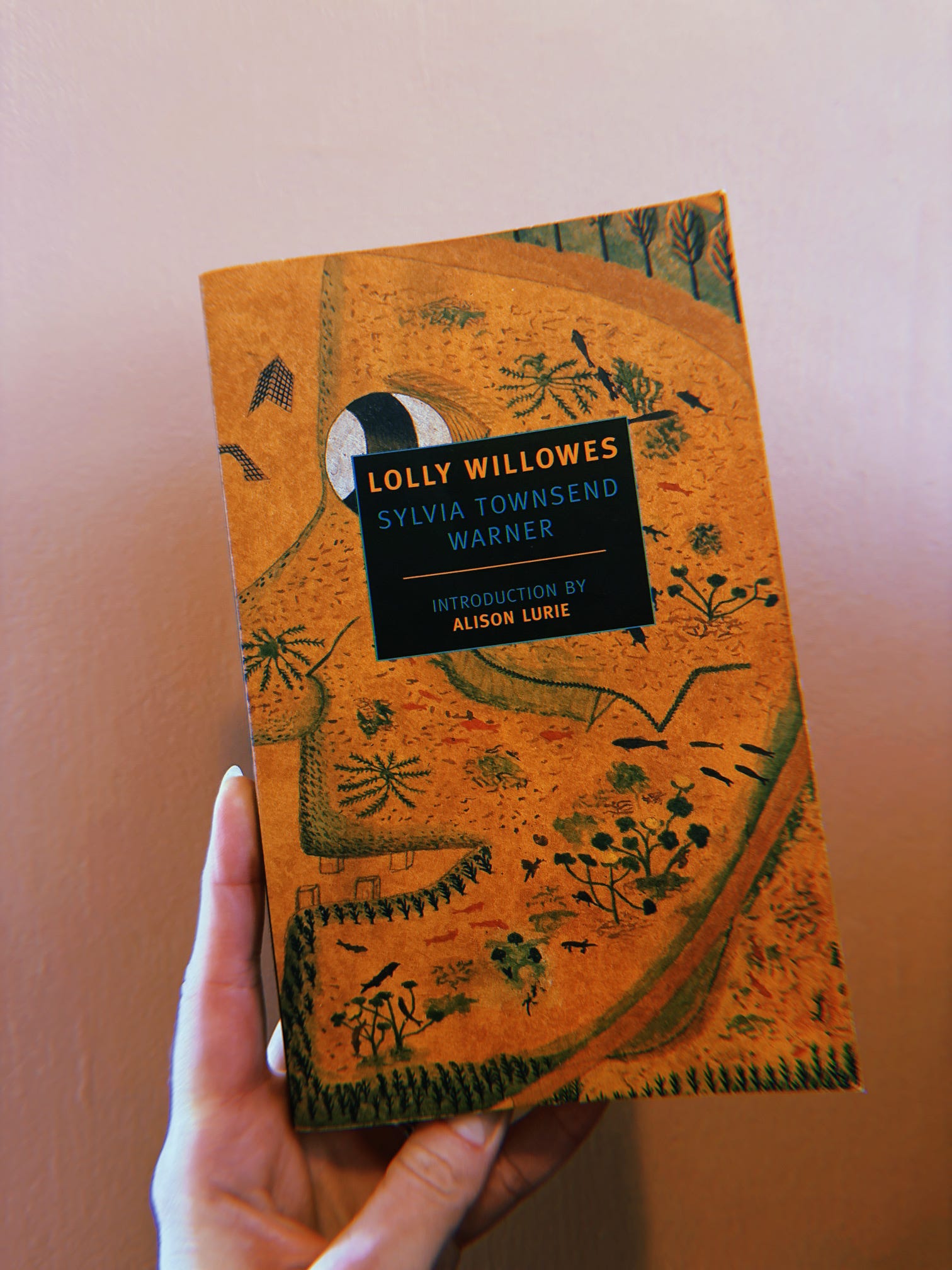
Renewal, fresh beginnings, the promise of a new path. All these things are apt for sinking into Lolly Willowes, which follows a single woman who seeks a new life for herself in the Chilterns after shuffling between family households her whole life.
Laura’s first move comes at 28. Following the death of her father, she moves to London to live with her brother, his wife, and their children. To her family, Laura is Lolly. It’s not a name she claims, but one that her siblings and their families call her. Elsewhere, she’s Laura. Laura takes long walks, runs errands, joins the family on vacations. Following one such vacation, Laura returns to London unmoored: “Her disquiet had no relevance to her life. It arose out of the ground with the smell of dead leaves: it followed her through the darkening streets; it confronted her in the look of the risen moon. ‘Now! Now!’ it said to her: and no more.”
Primal urgency underlies this anxiety. Nature is a meditative key Laura keeps turning in “a peculiar kind of day-dreaming, so vivid as to be almost a hallucination: that she was in the country, at dusk, and alone, and strangely at peace.”
I’m in anytime we’re hallucinating, anytime we’re daydreaming. Anytime someone is imagining something other than what’s before them. But I think there’s also something intersting about how Laura’s recognition takes shape. There’s this negation, this intensity of changing her life at that precise moment—the moon urging her Now!—and that give sway to a hazy sort of lucid life. It’s not life with her sibling’s family she wants, so what then?
It’s nature after all that ends up pointing Laura away from Apsley Terrace. During an errand, Laura becomes smitten with chrysanthemums, which the shopkeeper tells her come from Buckinghamshire. So moved by the flowers’ beauty, the rich earthy smell that embodies “her autumn imagination,” Laura buys a map of the Chilterns and plots her exit.
Laura, “Lolly,” discovers in her new home of Great Mop the joys of the trees, the stars, the frost, eccentric neighbors and unique shops. It’s a life of pleasure, slow living, and intention. I found it telling that the first few pages of the novel felt narrated from outside Laura, as if Caroline—her sister-in-law—was narrating Laura’s life for her, determining where to put Laura in the house, pre-empting family feuds over furniture. Meanwhile, Laura “had picked a red geranium flower, and was staining her left wrist with the juice of its crushed petals.” While everyone around Laura makes arrangements, concerns themselves with furniture, and so on, her mind is elsewhere, read: outside.
This splits between interiors and exteriors, domesticity and nature, thread through the book. Laura’s move shifts the novel’s environment geographically and psychically. From interiors/furniture/sharp edges to the living breathing woods and hills. Stuff of the earth. Moss. Mist.
Yet it also feels significant that the novel doesn’t seem to suggest a life of rugged individualism or hedonistic spinsterism. Laura’s new life includes getting to know her neighboring villagers, helping a neighbor care for chickens, and inhaling her surroundings with reverent affinity: “A slender moon soared in the green sky; the thick spring grass was heavy with dew, and the earth darkened about her feet while overheard it still seemed quite light.”
Shortly after her move, she takes joyful care selecting gifts for loved ones at the holidays. She’s not motivated by obligation and the desires of others. Rather, her gifts and acts are evidence of self-selecting affection.
I admire how Warner injects this new environment with eccentricity: an Inn called The Reason Why, villagers keeping late hours, strange music playing at night, a kitten mysteriously appearing in Laura’s home (and cementing her pact with Satan). If being lost—or feeling lost—is the cause or state, eccentricity is part of the answer, maybe even a balm to the malaise of a narrowing life path.
If the first third of the narrative seems driven by family history, new generations of children calling Laura “Lolly,” and movement from Lady Place to Apsley Terrace (and their respective interiors), the move to Great Mop turns its gaze toward what is lush, expansive, and possible in a lifetime. Any time Laura went out to look at the moon or the hills, to hike and drink in solitude, as well as her surroundings, the leisure felt balanced with respect for the natural world, as well as admiration for a life well lived on one’s own terms, not out of spite, but the deep human need to move through the world simply as you are.
While Lolly Willowes seems relatively subdued compared to contemporary witches, I think it’s kind of wild to think of this one first being published in 1926, nearly one hundred years ago. There’s the kitten scratch blood pact, sure. Also a witch Sabbath, complete with whirlwind dancing and masked characters. Even this, I love, how Laura seems underwhelmed by the affair. Totally unimpressed by a masked man holding court at the party. Later, during a pastoral moment overlooking yet another breathtaking view, Satan tells Laura about that masked man:
“He’s one of those brilliant young authors…He sold me his soul on the condition that once a week he should be without doubt the most important person at a party.”
“Why didn’t he sell his soul in order to become a great writer? Then he could have had the party into the bargain.”
“He preferred to take a short-cut, you see.”
Warner took no shortcuts in subtly enchanting Lolly Willowes. The book is just weird enough to walk the line of folk-supernatural, brimming with scenery that inspired within me a desire to go lay myself down upon some moss in the Chilterns. I was excited to learn that Lolly was the first Book of the Month Club selection. The book has since been a NYRB Classic, introduced by Alison Lurie, and more recently inducted into Modern Library’s Torchbearers Series, with an introduction by Mona Awad.
As ever, I love all the earthy details; the weather and nature and environment; the tilt from claustrophobia to fresh air, expansion; and that this book keeps finding new life. I hope it finds you and your familiars, too.
X
I haven't read this yet but it sounds so beautiful