

Poems in the Pool
On Tove Ditlevsen's Selected Poems

I borrowed my dog’s swimming pool during the heat wave. After melting to the post office and at my various desks, I took a break from (more!) work to cool off, read, and listen to birds. Since the fall, I’ve been dipping in and out of Tove Ditlevsen’s There Lives a Young Girl in Me Who Will Not Die, translated by Sophia Hersi Smith and Jennifer Russell. This selection of Ditlevsen’s was a long-awaited follow-up to The Copenhagen Trilogy, which I devoured five summers ago under the very same tree, at a time when I was living a somewhat different life.
And I suppose verbs of consuming here work because since first reading Ditlevsen, I’ve often thought of her as a writer who devoted herself to her work and whose work devoured her. But I’m getting ahead of myself.
Tove Ditlevsen, for the uninitiated, is a Danish writer (1917 - 1976) who left us a treasure trove of poems and The Copenhagen Trilogy, a trio of memoirs: Childhood, Youth, and Dependency1. Through these books, we swim through Ditlevsen’s upbringing in a working-class family, her writing life, literary career and publishing experiences, marriages (four!), motherhood, and opioid dependency. I hadn’t picked up The Copenhagen Trilogy in a long while, but when I revisited it, I realized that perhaps one of the reasons these books inhaled me had something to do with the sparing use of paragraph breaks, dialogue folded into narrative, the maelstrom of complete immersion in Ditlevsen’s straightforward, determined voice. The book is relentless in its accumulation, inducing one of my favorite states of reading, one of surrender. If I pick up The Copenhagen Trilogy I’m likely to disappear into it all over again.
This time, I revisited some favorite passages, including a reply from an editor responding to one of Tove Ditlevsen’s early submissions of poetry. Another in which she describes receiving the finished copy of her first poetry collection:
“One evening when I come home, there’s a big package lying on the table, and I tear it open with shaking hands. My book! I take it in my hands and feel a solemn happiness, that isn’t like anything I’ve ever felt before. Tove Ditlevsen. Pigesind. The book will always exist, regardless of how my fate takes shape.”
When I first read The Copenhagen Trilogy, a source I’m forgetting now translated Pigesind as Girl-Soul, while the selected collection of poems I’ve been working through translates the title as A Girl’s Mind. When I learned of There Lives a Young Girl in Me Who Will Not Die, I was excited to read Ditlevsen’s poetry in English translation and also that an echo of her first collection had endured for this selection. A nod to the author’s own idea that “the book will always exist.” Pigesind endures, here supplemented with poems reflective of an entire career.
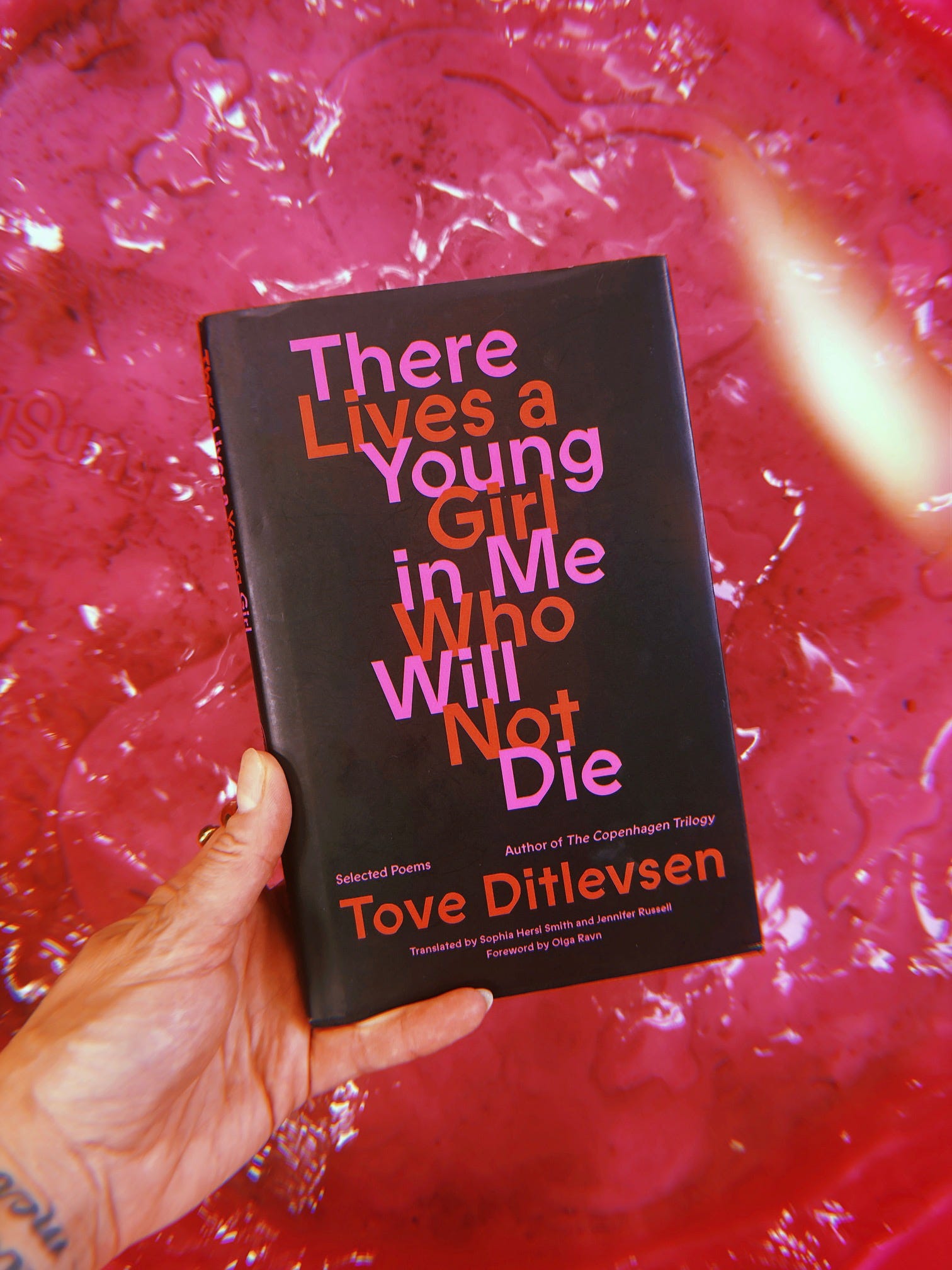
The poem “There Lives a Young Girl” appeared in Ditlevsen’s third collection, A Woman’s Mind, and it reflects upon carrying a younger self through adult life, carrying hard-won wisdom and being able to reflect on the past. This is a past filled with expectations, dreams, hope. One the speaker can’t quite catch in the mirror when she tries to square off with this young girl: “I try to catch that pale, shimmering gaze…” It’s the shimmering here for me, the light the speaker can recognize within this younger self.
I’ve wondered on a personal level, as well as a cultural and social level, whether there’s a longing for the young girl within to die, or at the very least vanish. If this is the true ticket to being taken seriously. If stepping fully into womanhood seems underwritten by a silent pact to leave behind every trace of girlhood. If the girl must die so the woman may outpace, outperform, outshine, outlast her. If there’s any way to carry both at once. If vulnerability, when misinterpreted, casts emotions as negotiable.
Ditlevsen’s unsentimental earnestness is a high-wire act of attention and care as she trains her mind on writing, her career, home life, work and structures hemming in our days. When I read these poems, I feel a gap between the life the speaker is living, the life she wants to live, and the world in which she exists.
Perhaps this is a symptom of growing older, the window of possibility assumed to be closing, creating a life that no longer fits, as in “The Adults 2. She writes, “It can happen/at any moment./Your age/tightens across/your chest like a/dress sewn/for someone else.” It’s a sudden shift delivering one from one life stage to the next. I like the use of second-person here, which could include both the reader alongside the speaker. Yet I also think this use of second-person is somewhat sneaky, casting distance between the supposed adults and the speaker. This hunch solidifies in the concluding lines: “The adults are gone/and never coming home.” The speaker may be an adult, but not in the way those she’s describing the poem’s adults. She’s somehow separate, attuned to everyone’s reactions, the strange slope of floors in a dwelling. She’s definitely not “one of them” and second-person is this poem’s subtle way of saying so.
Little, if anything, Ditlevsen lays on the page resists clear-cut interpretation. At the same time, for the plainspoken nature of these poems, the speaker’s vantage inhabits life with close attention and immediacy while observing (and articulating…) her perspective on that life from a remove. This distance is unique not in a desire to hold a reader at arm’s length, the openness here is too sincere to exclude us, but rather to hold the twin minds of existence and observation, the mind always twisting a line or sentence because that is how the author lived. We could call this perspective a sensibility, or perhaps a girl-soul.
For those curious how I ate strawberries this week, besides standing in the open fridge and eating them, I made a strawberry pretzel pie. A little slutty. Very summery. Perfect for putting on your best little outfit and reading horoscopes on the front porch.
X
A tender vittle of trivia. The third memoir in Danish is called Gift…which translates to married or poison.