

Linguistic Chimeras
About a pair of shorts, plus a writing exercise

As warm, summery weather arrives in Ithaca for what seems like real this time, I’m pulling out the sundresses and bike shorts, but one garment in particular inhabits my imagination and fashion dreams. Nostalgia-drenched as a Pez dispenser or Super Nintendo, I’m daydreaming of Soffe shorts.
I had a pair or two of off-brand Soffe shorts in my youth, though I was never a cheerleader. These paired best with band T-shirts. And there were significant sartorial choices that came with wearing them: did you let your Taking Back Sunday shirt hang or tie it? If tied, did you opt for a center or off-center knot? Did you secure the knot with a hair tie, rubber band, or scrunchie, or did you twist and knot the shirt in on itself? How many times did you roll the waistband of your shorts? How many times were you told not to roll them twice or thrice?
Last year, I designed, but did not purchase, this pair of shorts, which I believe would be but another stone gently placed in my life path of being every litbro’s nightmare, if only I had the courage to get them printed and wear them in public, though perhaps this is an outsize wish and people would simply be confused.
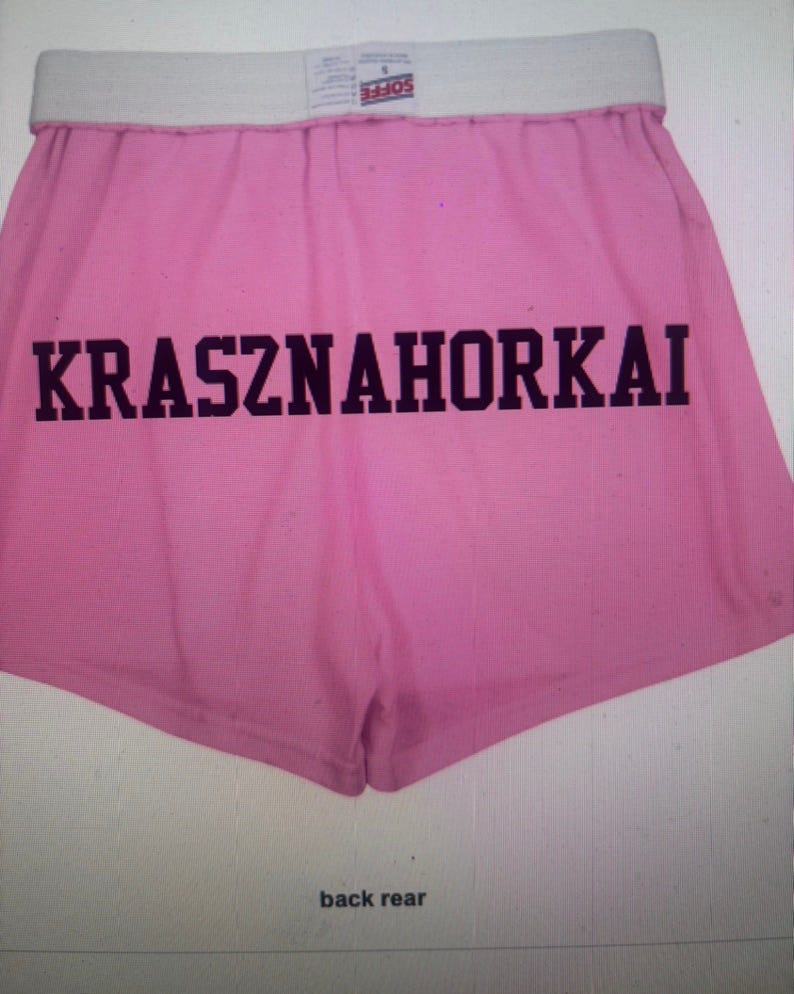
Confusion, however, can be an invitation to delve deeper into our innermost mysteries and, more broadly, our shared humanity and the reality that none of us will be here as long as we likely think we will. Which makes me think of this digital artifact I stumbled upon some years ago, but not that many:
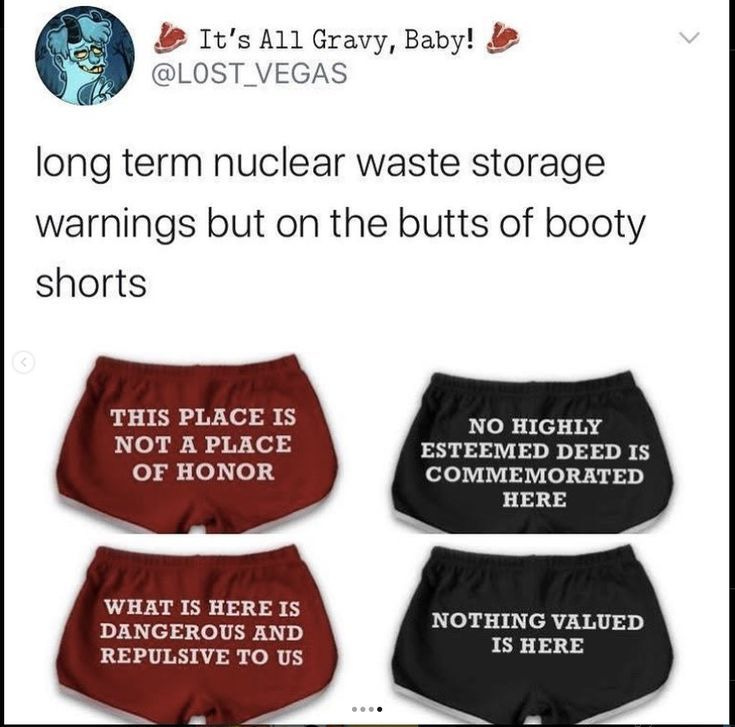
To see the fashion of my youth emblazoned with toxic waste messaging tastefully, or distastefully (depending on who you ask…), emblazoned across what in this case appear to be not Soffe shorts but rollerskating shorts (peep that thigh trim) embodied a peculiar emotion I imagine would have a word in languages besides English, or rather, feelings the English language has yet to succinctly translate.1 Emotive amalgams. Linguistic chimeras, felt but unnameable in this tongue. Pessoa’s “presence of absence,” or saudade. Ikigai. Schadenfreude. Fernweh.
These toxic waste messaging shorts found me about the time when I first read John D’Agata’s About a Mountain, which was when nuclear semiotics joined the constellation of my favorite rabbit holes/obsessions/non-sequitur subjects to raise at a dinner party.
About a Mountain details D’Agata’s time living in Las Vegas, where his mother has moved, volunteering at a mental health crisis call center, which was around the time a teenager jumped off the Stratosphere, about which time D’Agata also learned about the US government’s proposed designation of Yucca Mountain as a suitable site to store nuclear waste. In short, this book lives in my mind as an OG extended lyric essay bent through with facts, or complicated facts,2 organized into chapters that hold to the six tenets of journalism (who, what, where, when, why, how). This approach lends the essay freedom to roam and cohesive trail markers. I don’t mind getting a little lost, somewhat distant from where a chapter began, or the last one ended.
My fascination with, and the details I return to in, About a Mountain shift each time I pick it up. Yet among my most enduring haunted fascinations with this book is the mountain. The thing about spent nuclear fuel is that it’s an environmental nightmare. You can’t simply entomb drums of the stuff in a mountain and hope for the best. That material takes quite a minute to decay. Thus, the problem (or one problem…) the Yucca Mountain nuclear waste repository posed: What would happen in the future as those radioisotopes continued their slow decay? And, more importantly, how would it be possible to communicate to humans in the future, whose language may have transcended whatever our version of it is now, that they’d approached a dangerous site?
And lo…nuclear semiotics. A branch of linguistics devoted to solving this problem. One puzzle piece is the language, another is the how that language is passed on. So it’s the message itself “Dangerous place; bad shit here” (conveyed in the most simple, straightforward way possible…in other words, I would be very bad at making this signage) and the mode of communication. It’s like (1) drafting a letter in your mind while you’re walking around and then sitting down to write it and then (2) actually sending said letter and making sure the recipient who needs to read and understand it can read and understand the letter. In the case of Yucca Mountain, another puzzle piece was creating enduring signage that would withstand the elements, outlast vandals and time, and ultimately convey the simple, straightforward message to hypothetical human-animals in the future.
Of the examples of proposed signage and language D’Agata cites, my favorite is a series of monoliths, or “howling stones,” which would create a mournful, foreboding sound when the wind tore between them, ostensibly deterring visitors from going any farther. In the years since first reading, About a Mountain, any time I’ve heard my neighbor’s wind chimes, or thought of 2001: A Space Odyssey, I’ve thought of these markers, that wind and wail.
And I’ve thought of talking across time and intentions and truths. Oddly, nuclear semiotics has always reminds me of connection. How do you reach across a stretch of time to convey urgency? Grasping towards your precise feelings, then the exact language, and then finding a way to send the letter. The vulnerability and risk it takes to lay yourself on the line. The fear that saying the wrong thing could result in the nuclear option.
With this in mind, and in honor of the Blue Moon in Sagittarius, here’s a writing exercise, which I hope you’ll find intriguing. Make a monument to a memory or a moment in your life you have long struggled to translate.
You will want:
-one hour of time
-three blank & loose sheets of paper
-your chosen vessel for freewriting (journal or laptop, you do you)
-a writing utensil, for sure
-favorite sketch/art object (if you do that, but if not, your writing utensil is perfectly fine)
On the first blank sheet of paper: Outline the basics of your memory or moment that you can remember. We’ll riff off D’Agata’s organizing principle for About a Mountain and try: who, what, where, when, why, how. Make a simple list.
On the second blank sheet of paper: Select your materials. From what are you building your monument? Make another list.
On the third blank sheet of paper: Sketch your structure.
Either lay out your three sheets or tape them to the wall before you. Write for fifteen minutes, uninterrupted. I tried to find some foreboding wind audio for you. Alas, all I found was Halloween music. I like this exercise to Valium Aggelein’s Black Moon, which is the closest I will ever get to space because I am neither a rich nor a space-faring woman.
If you have time after the first pass, I’d take what you’ve written and rewrite it, filling in the spaces where things get fuzzy or distant, expanding to ultimate excess.
Then I’d probably put whatever you’ve written in a drawer for a week. Ideally, in a folder with your lists and sketch. Come back in a week and see what else shakes loose next time you take a crack at this one.
The results of this exercise are yours, all yours. If you’d like, share in the comments how it went for you because I’d love to know. Is your monument “dangerous and repulsive”? Did your materials hold up or collapse?
I’m also curious to know which nuclear waste messaging most resonates with your soul. Me? I’ve always been a “This place is not a place of honor” woman.
X


Writer Brittany Leitner has a poetry chapbook called 23 Emotions, in which she explores a sample of these wondrous words. A favorite of mine.
D’Agata’s Believer essay “What Happens There” inspired a lengthy, debate-filled fact-checking process between the author and Jim Fingal. The conversation spanned seven years and was later published as a book, The Lifespan of a Fact, which was later adapted for stage.
I wanted the ones that said CHEER, mind you, I was not a cheerleader. My favorite pair were bright red and I rolled them twice because nothing ever fit me properly. The edges of the leg holes always flared out and made it look like I was wearing a skort.
I'd like to put in an order for a pair of those shorts, please.