

Her Cosmic Parasites
On THE OLDEST BITCH ALIVE by Morgan Day

You swallow something and wake anew. Isn’t that the beauty and danger of a trip?
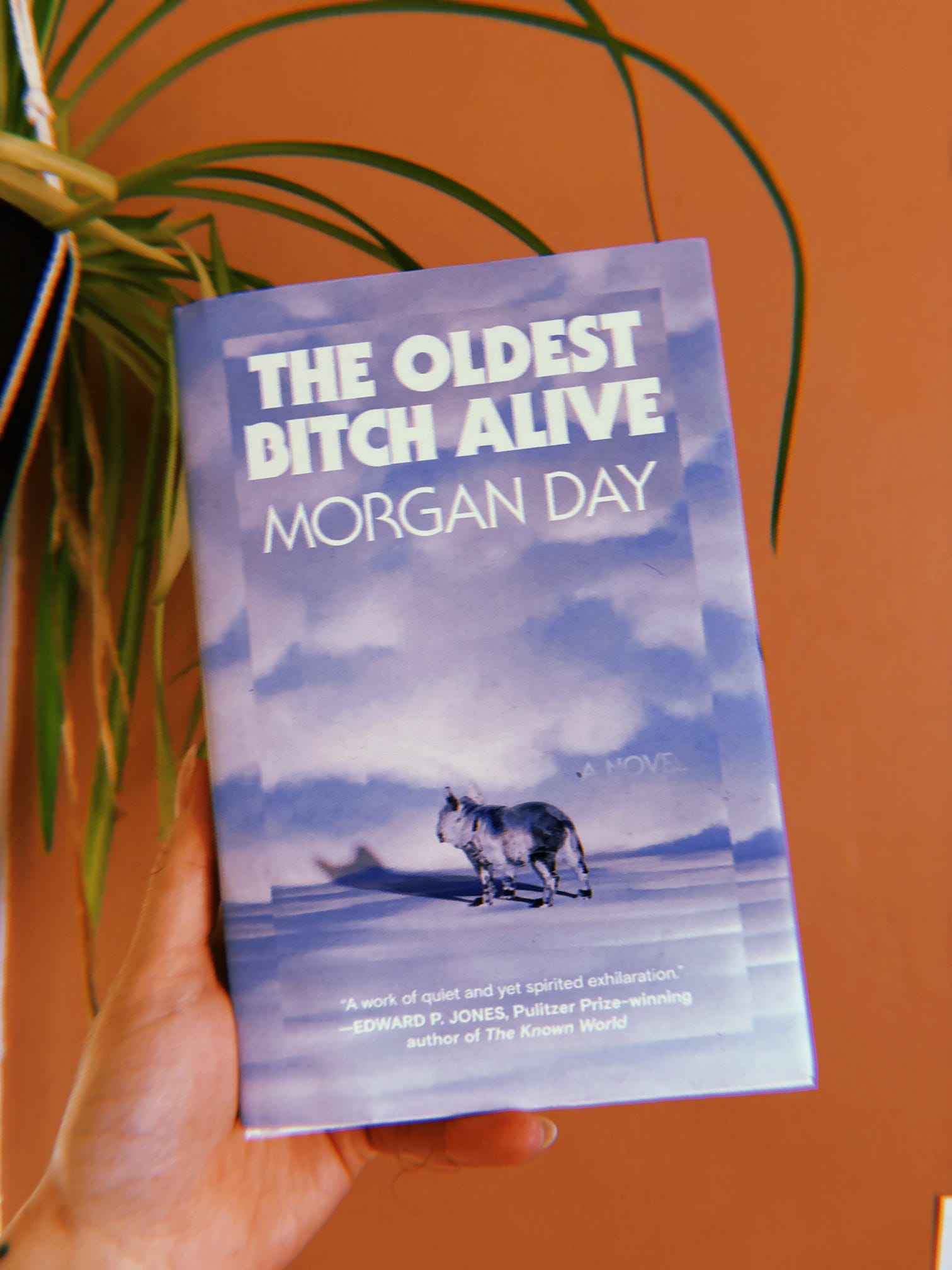
I recently read Morgan Day’s debut novel The Oldest Bitch Alive, the existential tale of Gelsomina, a French bulldog and her worms. This wildly original cosmic ride is a lyric meditation on life, death, environments, existence, and suffering. I was mesmerized by the shifting perspectives of Gelsomina and her parasitic inhabitants…all of whom sing together to remind me life can feel short and long, we can feel together and alone, and something—I’m still not quite sure what—glues all of us together in a tapestry of life, death, awareness, responsibility, and grasping toward understanding.
I picked this book up about a year after having my own parasitic close encounter. Mine was a tick, not worms, and we never formally met. Though this creature’s attachment to me caused strange symptoms to crop up. I wandered town with a constant dull headache for weeks, believing myself hormonal, allergic (to pollen or the paint I’d been casting in my kitchen after deciding I was over the blue shade I’d chosen years before), depressed, unmoored, susceptible to Ithaca’s temperamental iterations of spring. One morning, Gram Parsons and Metallica played while I rolled the final coat of gold onto an accent wall in my kitchen, a bid to conjure a sunnier atmosphere. After showering, I noticed multiple red blooms on my skin. Neck and armpit, beneath my left breast, up and down my legs. “A paint allergy,” I decided. “At least the kitchen is done.” Days later, more spots appeared, a lymph node in one armpit throbbed. I went to the doctor, who quickly pointed out I had early disseminated Lyme disease before sending me on my way with a Doxy prescription, which seemed to do the trick.
In The Oldest Bitch Alive, Gelsomina the dog ingests an orb of parasitic worms. She is both old and an old soul, reflected in the prose style, which flexes an omniscient lived-in wisdom, no matter who is speaking. The far-reaching voice creates an experience in which moments of mild disorientation feel organic. We’re in good hands, carrying us through a trajectory that’s as uncertain as the pulse of life. This is a book tuned into certainty’s ebb and flow, which is perhaps the only certainty of existence.
Adding to the uncertainty are the book’s fearless polyphonic risks. Perspectives shift from chapter to chapter, a chorus of creatures harmonizing, or disharmonizing, energies colliding. The shifting narration refracts the experience from different angles. Yet harbored within the same novel, these voices create a collective, reminding us of the interconnected nature of the world, the undeniable matrix of existence: planet, plants, animals (human and nonhuman).
This tension feels profoundly pronounced between dog and worms, as well as among the worms themselves. As a collective, initially joined in an orb, they share an agenda of inhabiting their host. Yet as they journey through their host, one worm reflects upon their sense of being. Their stakes are as real as Gelsomina’s: they’ll feed upon her, enough to sustain themselves, yet what happens when the host dies? The worms’ lives push and pull between thriving and suffering, backlit by a humanizing awareness that there is no individualism, only the interconnected systems of creatures, environments, and circumstances. One of my favorite chapters orbits the parasites in a kaleidoscopic meditation on worms. This primordial collage is a stream of consciousness weaving science, love, news articles, etymology, environment, and medicine. Not a detour. Not a distraction. Just another way life tangles to break apart again.
Environment feels similarly significant. The couple’s architecturally innovative glass house for me echoes the ultra-styled apartment of the characters in Vincenzo Latronico’s Perfection. Though Wendy and John are an interior designer and architect, rather than digital nomads, there’s this sense of self-curation. This reverberation sounds even louder when I consider the couple named their dogs after the protagonists in Fellini’s La Strada, they attend a Turrell installation. These are art people. This is an art house. At one point, John diagrams the house, within which he uses dots to represent the Gelsomina and Zampanò, their locations within the structure. In this artful living, there’s a grasping towards a certain kind of self, an attempt to wrestle order into the physical spaces we occupy, the vessels that contain us. We are creatures within systems, illnesses, and environments; we’re nesting dolls within larger firmaments, opening into other worlds, harboring entire ecosystems.
While reading The Oldest Bitch Alive, the atmosphere at times called to mind the concluding chapter of László Krasznahorkai’s The Melancholy of Resistance.
